
How I Said Goodbye to Expensive Progressives and Found the Perfect Reading Glasses (My the brand Story)
How I Said Goodbye to Expensive Progressives and Found the Perfect Reading Glasses (My the brand Story)
Last March, I was sitting at my kitchen table squinting at a recipe on my phone. My neck was bent at this weird angle, all craned down. My fancy progressive lenses were supposed to make reading easier, but instead I got headaches and a stiff neck every single day. I remember sitting there thinking, “I dropped $550 on these things and I still can’t read a simple recipe.”
That was the moment I knew something had to change.
The Challenge: When Spending More Doesn’t Get You Better
Here’s the backstory. About a year ago, my close-up vision started getting blurry. Normal aging stuff. I went to a chain eyeglass store and shelled out nearly $900 for two pairs of glasses. One pair was for the computer. The other was progressive lenses that were supposed to handle reading, computer work, and driving all in one.
The progressive lenses were a total disaster. The reading zone was so tiny I could only make out a few words at a time. The mid-range zone was just a sliver. I had to bob my head up and down like a bird just to get through a full page. My neck hurt all the time. And the top part meant for distance gave me double vision.
I went back. They re-examined me. The new doctor was rude—insisted I just needed to “learn to use” progressives, then rushed me out. I ended up with two pairs of computer glasses and nothing for reading. $900 down the drain.
Then I tried an online glasses retailer. Three pairs came back blurry, all wrong. I lost about $200 in store credits I could never use. Their return policy had me trapped.
The lesson was crystal clear:
- Expensive doesn’t always mean quality
- Progressive lenses aren’t for everyone
- Sometimes simple reading glasses are the right answer
The Turning Point: Keeping It Simple
My friend Sarah noticed me struggling with a menu at lunch one day. She pulled out a pair of thick-framed reading glasses from her purse. They looked stylish—retro, like something out of a vintage movie.
“Where’d you get those?” I asked.
“the brand,” she said. “They’re just simple readers. None of that fancy progressive nonsense. I know my strength, and they work perfectly.”
She told me the key was knowing your numbers. Not just your prescription strength, but your pupillary distance. I’d never heard of that before. She showed me how to measure pd at home. It took about two minutes with a ruler and a mirror. That measurement tells you the distance between the centers of your pupils, and it matters because it determines where the optical center of each lens sits in front of your eyes.
Without the correct PD, even the right prescription can feel off. Things look blurry at the edges. Your eyes strain. Sound familiar? That might have been part of my problem all along.
Choosing the brand R56528 Readers
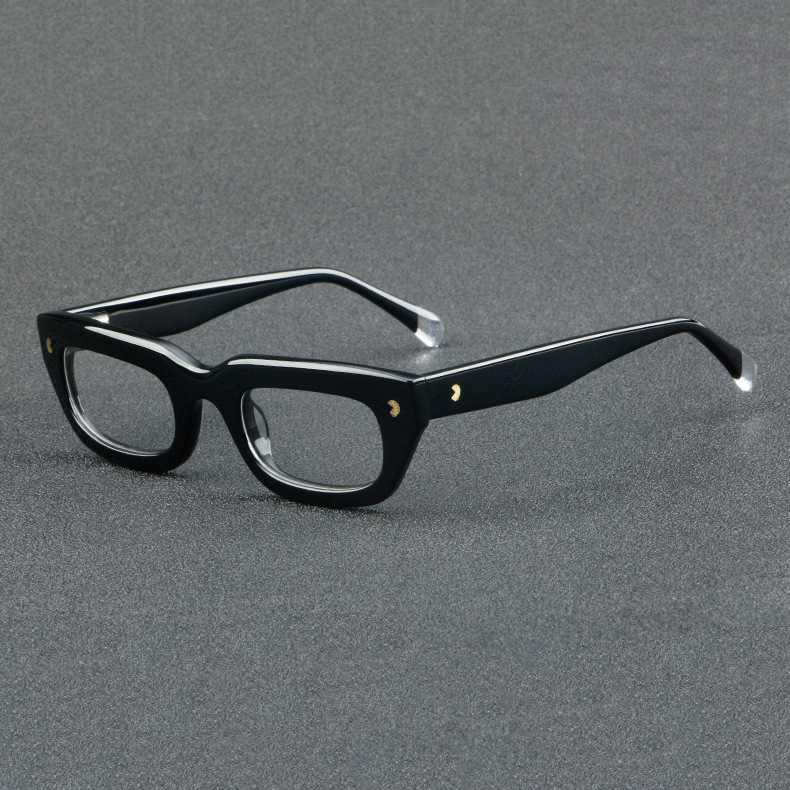
I looked up the brand R56528 Small Frame Thick Acetate Reading Glasses. They come in several strengths: +1.00, +2.00, and +3.00. The style is retro with small rivet details on the frame corners. The acetate is thick and solid—they feel like real glasses, not flimsy drugstore readers.
Here’s what I considered before buying:
- My reading strength: I tested at +2.00 during my last exam
- My PD measurement: 62mm, which I confirmed at home
- Frame size: Small frame works for my face shape
- Style: The C1 Black color goes with everything
Verdict: Know your numbers before you buy. Measure PD at home. Confirm your reading strength. Then pick your style.
Life After: Three Scenarios Where These Glasses Shine
Scenario 1: Morning coffee with a book. The first day I wore them, I sat down with my novel and a cup of coffee. I read for 45 minutes straight. No head bobbing. No neck pain. The entire page was clear. I almost cried. After months of struggling, reading felt easy again.
Scenario 2: Cooking dinner. A week later, I was making a new pasta dish. I had the recipe on my phone propped up on the counter. I could read every line without tilting my head. I could glance at the ingredient list and back to the stove. Simple. Natural. The way it should be.
Scenario 3: Working from home. I keep these at my desk now for reading documents and checking my phone. For the computer monitor, I still use my computer glasses at the right distance. But for anything within arm’s reach, the brand readers are perfect.
Price vs. Quality: What to Expect
These glasses are budget-friendly. That’s a fact. So let me be honest about the tradeoff.
- What you get: Solid acetate frames, clear lenses at a fixed strength, retro style, comfortable fit
- What you don’t get: Custom prescription, anti-reflective coating, photochromic lenses, progressive zones
For simple presbyopia (age-related farsightedness) where you just need help reading up close, these work great. They won’t replace custom prescription glasses for complex vision needs. But that’s the point. Sometimes simple is better.
Quality indicators to check:
- Hinges should feel tight, not wobbly
- Acetate should be smooth with no rough edges
- Lenses should be clear across the entire surface
- Look at real buyer photos in reviews before ordering
Verdict: Great value for dedicated reading glasses. Don’t expect them to do everything. That’s not their job.
Why Measuring PD Matters More Than You Think
Looking back at my progressive lens nightmare, I wonder if an incorrect PD measurement was part of the problem. When the optical centers don’t line up with your pupils, you get eye strain. You get narrow clear zones. You get headaches.
Even with simple readers, you want to measure PD correctly. For those who have almost any inquiries with regards to where by and also how you can work with www.mozaer.com, you possibly can email us in our web-page. It takes two minutes. You need a millimeter ruler and a mirror. Or have a friend help. the brand makes this easy to understand on their site.
Here’s my buying process now:
- Step 1: Get an eye exam to confirm your reading strength
- Step 2: Measure PD at home (or ask your optometrist)
- Step 3: Compare frames and read real reviews with photos
- Step 4: Buy and test within the return window
Coming Full Circle
Last week, I was back at that same kitchen table. Same recipe app on my phone. But this time, I slipped on my the brand R56528 readers and the whole screen was sharp. No neck craning. No squinting. No $900 regret.
My neighbor was over for tea. She watched me put them on and said, “Those are cute. Where’d you get them?”
I smiled. “Let me tell you a story,” I said.
Not every vision problem needs an expensive, complicated solution. Sometimes you just need a solid pair of reading glasses, the right strength, and a correct PD measurement. That’s it. That’s the whole secret.
Final Verdict: Research your needs. Measure PD accurately. Start simple. Check reviews with real photos. the brand R56528 thick acetate readers are a smart, affordable starting point for anyone tired of overcomplicating their reading vision.